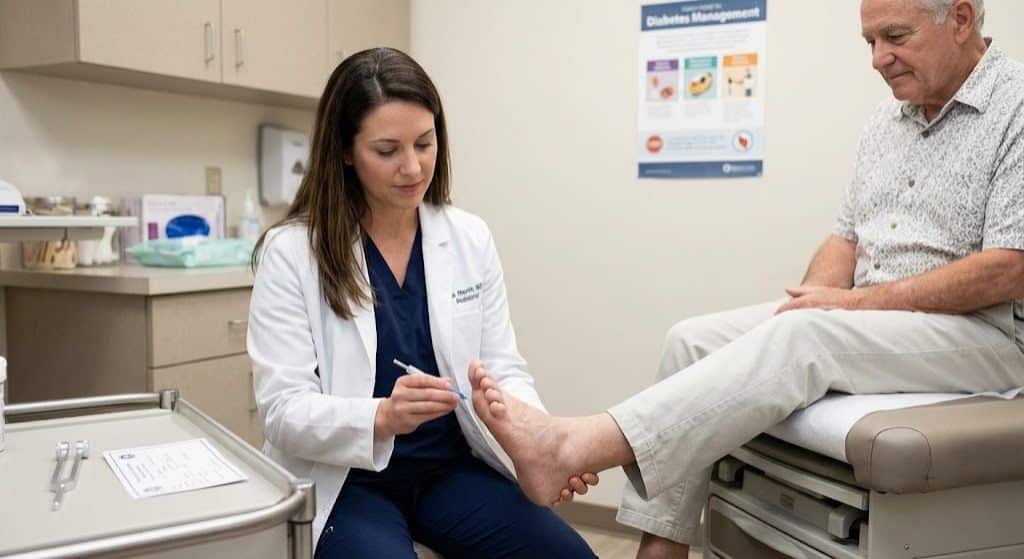
Managing diabetes requires daily attention—from monitoring blood sugar and eating balanced meals to staying active and keeping up with medical care. Yet one important part of staying healthy and independent can be easy to overlook: protecting your feet.
Diabetes can affect sensation, circulation, skin health, and the way wounds heal. In some cases, a foot problem can develop without causing much pain, which is exactly why preventive care matters.
A comprehensive diabetic foot exam can identify changes in sensation, circulation, skin condition, foot structure, and pressure areas before they develop into more serious problems. For patients in St. Clair Shores, Fraser, and surrounding Metro Detroit communities, regular diabetic foot care can play an important role in protecting long-term mobility and independence.
In our practice, the majority of serious diabetic wounds we treat started as something small — a callus, a pressure spot, a minor crack — that went unnoticed because it didn’t hurt. Catching those changes at a routine exam, before they progress, is what preventive foot care is really about.
Why Diabetes Can Affect Your Feet
Over time, diabetes can damage nerves and blood vessels throughout the body. The feet are particularly vulnerable because diabetic peripheral neuropathy often affects the longest nerves first, while circulation problems can make injuries more difficult to heal.
Two major concerns are:
- Nerve changes (neuropathy): Diabetes can damage peripheral nerves, reducing your ability to feel pain, pressure, heat, cold, or injury in your feet. This is known as diabetic peripheral neuropathy.
- Circulation problems: Diabetes increases the risk of peripheral artery disease, which can reduce blood flow to the legs and feet. Poor circulation may slow wound healing and make infections more difficult to fight.
When reduced sensation and circulation problems occur together, even a small cut, blister, callus, or pressure point can become more significant.
A person with normal sensation may immediately notice a pebble inside a shoe or a blister forming on a toe. Someone with neuropathy may continue walking without realizing the skin is being damaged.
That is why preventive diabetic foot care is important even when your feet feel completely fine.
What Happens During a Diabetic Foot Exam?
Many patients wonder what to expect during their first diabetic foot exam. The evaluation is generally simple, gentle, and non-invasive.
Your podiatrist may examine several important areas of foot health.
Nerve Sensation
Your podiatrist may use a thin nylon monofilament to gently touch specific areas of your feet and determine whether you can feel light pressure.
A tuning fork may also be used to evaluate vibration sensation, while other simple tests can assess additional types of sensation when appropriate.
These tests help identify loss of protective sensation—a major risk factor for diabetic foot ulcers.
Circulation
Your podiatrist may feel the pulses on the top of your foot and near the inside of your ankle to assess circulation.
The skin may also be checked for temperature, color, hair growth, and other signs that can provide information about blood flow. If the examination raises concerns about circulation, additional vascular testing or referral to a vascular specialist may be recommended.
Skin and Nails
Your feet are carefully inspected for:
- Dry or cracked skin
- Calluses and corns
- Blisters or open wounds
- Redness or swelling
- Fungal skin or nail changes
- Ingrown or damaged toenails
- Areas showing repeated pressure or friction
Even a seemingly harmless callus can sometimes develop over an area of excessive pressure, making it important to monitor.
Foot Structure and Alignment
Your podiatrist evaluates the shape and alignment of your feet and toes.
Conditions such as bunions, hammertoes, prominent bones, limited joint movement, or other structural changes can create pressure points inside shoes. When sensation is reduced, these areas may be repeatedly irritated without causing enough pain to alert you.
Your podiatrist is also watching for signs of Charcot foot (Charcot arthropathy) — a less common but serious condition in which weakened bones and joints in the foot can fracture or shift, sometimes with little or no pain due to neuropathy. Early detection is important, since an undiagnosed Charcot foot can lead to significant deformity if it isn’t identified and offloaded promptly.
Footwear
Your everyday shoes may also provide valuable clues.
Your podiatrist can check whether your shoes fit properly and look for areas of excessive wear, pressure, rough seams, or inadequate room around the toes.
Together, these findings help establish your individual risk for diabetic foot complications and determine how frequently your feet should be professionally evaluated.
Why Numbness Can Be More Concerning Than You Think
Pain is one of your body’s natural warning systems.
If you step on something sharp, touch a hot surface, or develop a blister from a poorly fitting shoe, pain normally tells you to stop and investigate.
Neuropathy can remove that protective warning.
If sensation in your feet has decreased, you may not notice:
- A blister developing inside your shoe
- A small cut or puncture
- Excessive pressure beneath a callus
- A hot surface causing a burn
- An object trapped inside your footwear
You may then continue walking on an injured area, allowing repeated pressure to cause additional tissue damage.
This is why loss of protective sensation can be particularly dangerous for someone with diabetes. When pain can no longer reliably warn you about a problem, regular visual inspection becomes even more important.
How a Small Foot Problem Can Become a Diabetic Ulcer
Diabetic foot ulcers do not all develop the same way.
In people with neuropathy, however, repetitive pressure over a callus, prominent bone, or poorly fitting shoe can gradually damage the skin and underlying tissue.
A typical progression might look like this:
- Repeated pressure: A particular area of the foot experiences repeated friction or pressure during walking.
- Skin damage: A blister, callus, crack, or other area of skin begins to break down.
- Continued weight-bearing: Reduced sensation may allow you to continue walking on the damaged area without realizing how much pressure it is receiving.
- Ulcer formation: Continued tissue breakdown can eventually create an open sore known as a diabetic foot ulcer.
- Possible infection: Once the skin barrier is broken, bacteria may enter the wound. If infection develops, prompt treatment becomes especially important.
Importantly, an ulcer does not have to be infected to be serious. Pressure, depth, circulation, location, and other factors all affect how well a wound can heal.
This is why diabetic foot ulcer prevention involves more than treating wounds after they appear.
Regular professional exams can identify risk factors such as neuropathy, circulation problems, calluses, deformities, and pressure areas. Daily self-inspection helps identify new changes that develop between appointments.
The 60-Second Daily Foot Check You Can Do at Home
A professional foot exam provides an important clinical assessment, but you see your feet every day.
Taking about a minute each evening to inspect them can help you identify a new problem early—especially if you have reduced sensation.
Your daily foot check
- Look at the tops and sides: Check for redness, swelling, cuts, blisters, cracks, or changes in skin color.
- Check the soles: Use a hand mirror or floor mirror to see the bottoms of your heels and forefeet. If you have difficulty seeing your feet, ask a family member or caregiver to help.
- Look between the toes: Check for peeling skin, excess moisture, cracks, or redness.
- Compare your feet: Look for unusual differences in temperature, color, or swelling between one foot and the other.
- Check your nails: Watch for ingrown edges, discoloration, thickening, or injuries around the nail.
- Inspect your shoes: Before putting them on, check inside for pebbles, torn lining, rough seams, or other objects that could injure your skin.
If you have reduced sensation, avoid walking barefoot—even around the house—because small cuts, splinters, burns, or punctures may go unnoticed.
Seek same-day or urgent care rather than waiting for a routine appointment if you notice fever, spreading redness or red streaking, a foul odor, drainage, or any darkening or blackened skin or tissue. These can be signs of a serious infection or limb-threatening complication and should not wait. For any other new wound, blister, persistent redness, swelling, or discoloration, contact your podiatrist promptly rather than waiting for your next routine visit.
Advanced Wound Care and Limb Salvage: What Does That Mean?
If a diabetic foot wound does develop, terms such as “advanced wound care” or “limb salvage” can sound intimidating.
The goal is straightforward: heal the wound, control infection when present, preserve as much healthy tissue as possible, and protect your ability to walk.
Diabetic limb-salvage care may involve several approaches depending on the wound and the patient’s overall health.
Pressure Relief and Offloading
Continued pressure can prevent a wound from healing.
Specialized boots, casts, braces, or therapeutic footwear may be used to redistribute weight away from the wound and allow damaged tissue to recover.
Wound Care
Different wounds require different types of care.
Your podiatrist evaluates the wound’s depth, drainage, tissue condition, location, pressure exposure, and other factors to determine the appropriate dressing and treatment approach.
Debridement
When appropriate, unhealthy or dead tissue may be carefully removed from a wound. This process, known as debridement, can help create a healthier environment for healing.
Infection Management
Not every diabetic foot ulcer is infected and not every wound requires antibiotics.
When signs of infection are present, your care team may obtain appropriate cultures and prescribe antibiotics based on the clinical findings and test results.
Circulation Evaluation
A wound may have difficulty healing if the foot is not receiving adequate blood flow.
When circulation is a concern, your podiatrist may recommend additional vascular testing or coordinate care with a vascular specialist who can determine whether treatment to improve blood flow is necessary.
Reconstructive Care
Some patients have structural problems that repeatedly place excessive pressure on a particular part of the foot.
When conservative treatment is not enough, reconstructive foot surgery may sometimes be considered to improve alignment, reduce pressure, and help protect the foot from recurrent wounds.
The goal of limb-salvage care is not simply to close a wound. It is to address the factors contributing to the problem and preserve mobility whenever possible.
Learn more about Eastside Podiatry’s diabetic limb salvage care.
How Often Should You Have a Diabetic Foot Exam?
People with diabetes should have their feet evaluated regularly—even if nothing hurts.
A comprehensive foot examination is generally recommended at least once a year. Your podiatrist may recommend more frequent visits depending on your individual risk.
People who may require closer monitoring include those with:
- Peripheral neuropathy
- Poor circulation or peripheral artery disease
- Foot deformities
- Significant calluses or pressure areas
- Previous diabetic foot ulcers
- A history of amputation
- Active wounds or infections
Your examination schedule should be based on your individual risk rather than a one-size-fits-all timeline.
Medicare, Therapeutic Shoes, and Referrals
Insurance coverage for diabetic foot care depends on your medical needs, risk factors, insurance plan, and the specific services being provided.
Medicare may cover certain medically necessary diabetic foot-care services for eligible patients who meet specific requirements.
Medicare Part B may also help cover therapeutic shoes and inserts for qualifying patients with diabetes who meet established medical and documentation criteria. The exact type and number of shoes or inserts covered depends on eligibility and the prescribed footwear.
Because coverage requirements can change and individual plans differ, it is best to verify your benefits before receiving services.
Do you need a referral to see a podiatrist?
That depends on your insurance plan.
Many patients can schedule directly with a podiatrist, while some insurance plans may require a referral or prior authorization. Our office can help you understand what information may be needed before your appointment.
Diabetic Foot Care in Fraser and St. Clair Shores
At Eastside Podiatry PLLC, our podiatrists evaluate sensation, circulation, skin integrity, foot structure, pressure areas, and footwear to identify each patient’s individual risk for diabetic foot complications.
Dr. Hatim T. Burhani, DPM, FACFAS; Dr. Siraj Panchbhaiya, DPM, FACFAS; and Dr. Bhavik Patel, DPM provide comprehensive foot and ankle care for patients throughout Macomb County and surrounding Metro Detroit communities.
With offices in Fraser and St. Clair Shores, our team provides preventive diabetic foot care as well as treatment for wounds and other foot complications.
Whether you need a routine diabetic foot evaluation, help managing calluses or nail concerns, therapeutic footwear guidance, or advanced wound care, treatment is tailored to your medical history, foot health, and individual risk.
Our goal is to identify problems early, help prevent avoidable complications, and protect your mobility and independence.
Frequently Asked Questions
How often should someone with diabetes see a podiatrist?
A comprehensive foot evaluation is generally recommended at least once a year for people with diabetes. Those with neuropathy, circulation problems, foot deformities, significant calluses, previous ulcers, or other risk factors may need more frequent examinations based on their individual risk.
Does Medicare cover therapeutic shoes and inserts?
Medicare Part B may help cover therapeutic shoes and inserts for eligible people with diabetes who meet specific medical and documentation requirements. Coverage varies depending on eligibility and the type of footwear prescribed, so confirm your individual benefits before receiving the shoes or inserts.
What should I bring to my diabetic foot exam?
Bring the shoes and socks you wear most often, a current medication list, your insurance information, and relevant information about your diabetes and medical history. If you have noticed a particular wound, pressure area, or shoe causing problems, mention it during your appointment.
Should I get a diabetic foot exam even if I don’t have pain?
Yes. In fact, the absence of pain does not necessarily mean your feet are free from problems. Diabetic neuropathy can reduce sensation, making it possible for pressure areas, blisters, or wounds to develop without significant discomfort. Preventive examinations help identify risk factors before complications occur.
What foot problems require prompt attention when you have diabetes?
Contact your healthcare provider or podiatrist promptly if you notice an open wound, new blister, drainage, increasing redness, swelling, discoloration, warmth, or other significant changes. If you notice fever, red streaking, foul odor, or darkening tissue, seek same-day or urgent care rather than waiting — these can signal a serious infection.
Are virtual visits available for diabetic foot concerns?
Virtual visits may be useful for selected consultations, visual reviews, and follow-up discussions when appropriate. However, a virtual visit does not replace a comprehensive in-person diabetic foot examination, which may require hands-on sensation testing, pulse assessment, evaluation of foot structure, and other clinical tests.
New wounds, significant redness or swelling, drainage, discoloration, suspected infection, or rapidly changing symptoms should be evaluated promptly and may require an in-person visit.
Protect Your Steps and Preserve Your Independence
Managing diabetes is a lifelong process, but protecting your feet doesn’t have to be complicated.
A comprehensive foot exam can identify risk factors you may not be able to see or feel, while a simple daily inspection can help catch new problems between visits.
Together, these preventive habits can help protect your feet, your mobility, and your independence.
Schedule a diabetic foot exam with Eastside Podiatry PLLC at our Fraser or St. Clair Shores office today.
Sources: American Diabetes Association Standards of Care (diabetes.org); Centers for Disease Control and Prevention (cdc.gov)