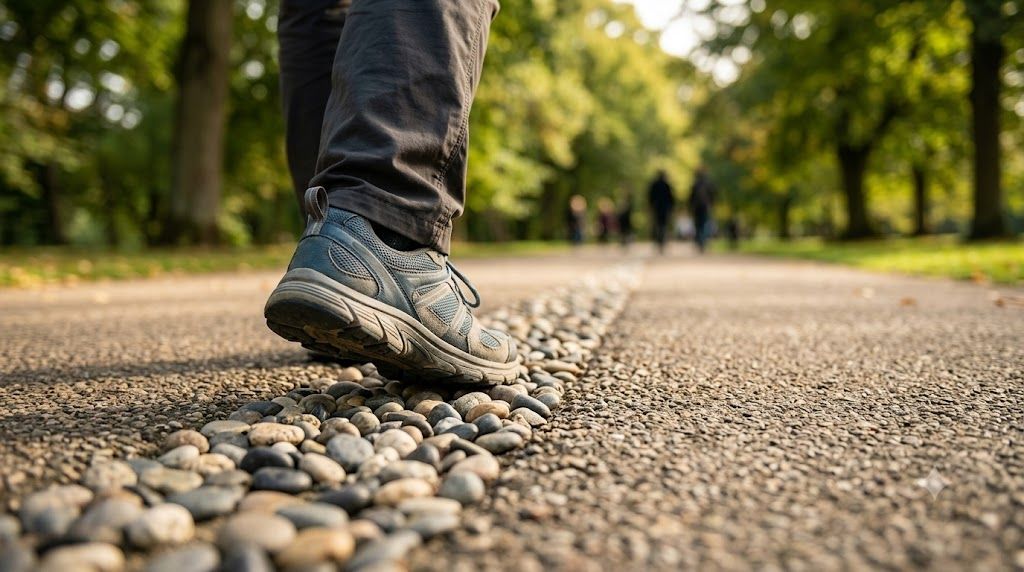
Summer in Southeast Michigan often means spending more time hiking local trails, golfing, walking along the Lake St. Clair shoreline, or participating in recreational sports leagues. Unfortunately, these activities can sometimes reveal an underlying foot condition known as Morton’s Neuroma.
Left unaddressed, this condition can turn a simple afternoon walk into an agonizing ordeal, forcing you to cut your favorite seasonal activities short and retreat indoors.
At Eastside Podiatry PLLC, we frequently evaluate patients from Detroit, St. Clair Shores, Fraser, and surrounding Wayne and Macomb County communities who describe Morton’s Neuroma as feeling like they are walking on a pebble or folded sock.
The Phantom Pebble: Understanding the Source of Your Discomfort
To find lasting relief, it is essential to understand what is happening beneath the surface of your skin. Morton’s Neuroma is a painful condition that affects the metatarsal area of the foot, most commonly developing between the third and fourth toes. Despite the intimidating medical name, a neuroma is not a tumor; rather, it is a benign, protective thickening of the tissue surrounding one of the digital nerves leading to your toes.
This thickening occurs in response to repetitive irritation, compression, or localized trauma. When the nerve is continuously squeezed between the long metatarsal bones, it becomes acutely inflamed. The body attempts to shield the nerve by building up fibrous tissue around it. This localized swelling creates the distinct physical sensation of walking on an actual object, such as a folded sock or a pebble. As you continue to walk, hike, or stand, your body weight presses directly onto this swollen, highly sensitive nerve, transforming a dull ache into a sharp, burning pain that can radiate outward into your toes, often accompanied by tingling or numbness.
Why Summer Aggravates Ball of Foot Pain
Many patients note that their symptoms escalate dramatically during the warmer months. This seasonal surge is directly tied to changes in activity levels and footwear choices. Summer hiking and long-distance walking require repetitive, high-impact forefoot loading, which continuously compresses the metatarsal heads against the inflamed nerve.
Furthermore, standard summer footwear often exacerbates the structural problem. Lightweight sandals, narrow athletic slides, and flexible minimalist shoes frequently lack the rigid structural support required to keep the metatarsal bones properly separated. When a shoe pinches the forefoot or forces the toes into an unnatural position, the space between the bones narrows significantly, trapping and compressing the nerve with every single step you take. What began as a minor, occasional annoyance quickly intensifies into a persistent structural issue that alters how you walk and threatens your daily mobility.
Reclaiming Your Stride: Advanced Clinical Solutions
You do not have to accept physical limitations or miss out on the lifestyle you love. Resolving Morton’s Neuroma requires shifting away from temporary, off-the-shelf fixes and pursuing targeted, expert clinical care. When searching for a qualified foot specialist near me, it is vital to select a practice that prioritizes a detailed diagnostic approach to discover the true source of your pain.
At Eastside Podiatry PLLC, our specialized team focuses on providing accurate, comprehensive evaluations to map out the ideal pathway for your recovery. Partnering with an experienced ball of foot pain doctor ensures you receive a customized strategy designed to alleviate nerve compression and reduce localized inflammation safely. Modern, effective morton’s neuroma treatment plans prioritize advanced conservative therapies. These options include precision-engineered custom orthotics fitted with specialized metatarsal pads to spread the bones and take direct pressure off the nerve, targeted anti-inflammatory injections to provide rapid relief, and professional footwear modifications that accommodate your foot’s natural shape without sacrificing your summer plans.
Restore Your Mobility and Comfort Today
If foot pain is preventing you from enjoying summer activities around Detroit, St. Clair Shores, Fraser, or surrounding communities of Wayne or Macomb Counties, schedule an evaluation with Eastside Podiatry PLLC today.
Our board-certified podiatrists, Dr. Hatim Burhani, Dr. Bhavik Patel, and Dr. Siraj Panchbhaiya, routinely diagnose and treat conditions ranging from plantar fasciitis and arch pain to Morton’s Neuroma and other nerve-related foot disorders.
Book a Neuroma Pain Assessment.
Let us help you eliminate the phantom pebble in your shoe so you can enjoy every step of your summer journey with complete confidence. Visit https://podeastside.com/ to schedule your evaluation.
Frequently Asked Questions
Is Morton’s Neuroma a type of tumor?
No, Morton’s Neuroma is entirely benign and is not a tumor or a cancerous growth. It is a localized thickening and swelling of the protective tissue surrounding a nerve in the ball of your foot, typically developing between the third and fourth toes due to chronic compression, friction, and structural irritation.
How can a ball of foot pain doctor distinguish a neuroma from a stress fracture?
While both conditions cause severe discomfort in the forefoot, an experienced specialist utilizes targeted clinical tests to differentiate them. A neuroma typically produces sharp, burning pain, tingling, or a “pebble-in-the-shoe” sensation, and often elicits a distinct mechanical click (known as Mulder’s sign) when the forefoot is compressed. Stress fractures, conversely, present as a deep, structural ache directly localized to the bone, often accompanied by visible swelling on top of the foot and worsening under load.
What does conservativemorton’sneuroma treatment involve?
Advanced conservative treatment focuses entirely on relieving mechanical pressure from the inflamed nerve. This typically includes transitioning to shoes with a wider, more accommodating toe box, utilizing custom orthotics equipped with built-in metatarsal pads to separate the bones, ultrasound-guided cortisone injections to eliminate localized swelling, and shockwave therapy to promote deep tissue healing without surgical intervention.
Will I eventually need surgery to remove the nerve?
Surgery is rarely the first step. The vast majority of patients achieve complete, lasting relief through non-invasive conservative therapies. Surgical excision of the neuroma is considered a secondary option, reserved strictly for severe or long-standing cases that do not respond to custom orthotics, footwear modifications, or specialized injection therapies.
Why should I see a foot specialist near me rather than waiting for the pain to fade?
Nerve irritation is progressive. When a nerve is continuously compressed, the surrounding protective tissue will continue to thicken, making the condition harder to treat non-invasively over time. Early intervention by a podiatrist prevents permanent nerve damage and allows for faster, simpler treatment options that restore your natural mobility immediately.